SEO for Massage Therapists: How to Get Found on Google, Google Maps and AI Search
One of the most obvious ways a new client finds a massage therapist is by searching for one! And if people near you are searching, and you show up in the results... then it's a great way to get new bookings.
"SEO" is the art of helping your site get found near the top of the search results, so that all those searching clients find you instead of your competitors. I've been working with businesses since 2004 (gulp!) helping them to get found more easily online.
But now, in 2026 and beyond, the question is no longer just "does your website get found in Google?" It's also "does AI recommend you?"
So in this guide I'm going to show you exactly how to get found by those potential clients who are out there looking for you right now – and I'll cover Google and AI.
Google Maps vs. AI
The way people search is changing. But before getting caught up in the "hype" around AI, it helps to know what is really happening.
87% of consumers use Google to find local businesses, and around 86% use Google Maps specifically to check a business out before visiting in person.
46% of all Google searches have "local intent" — meaning almost half of everything typed into Google is someone looking for a nearby service, like "massage near me."
76% of people who search for something nearby visit within 24 hours, and 28% of those searches lead to a purchase or booking. Local search like this is converting to real bookings.
For simple, high-intent local searches (like "massage therapist near me"), Google's map-based local results still appear over 90% of the time, while AI-generated summaries appear for only 15%. AI summaries dominate broader, informational questions instead (like "how often should I get a massage for back pain"), appearing there 90%+ of the time.
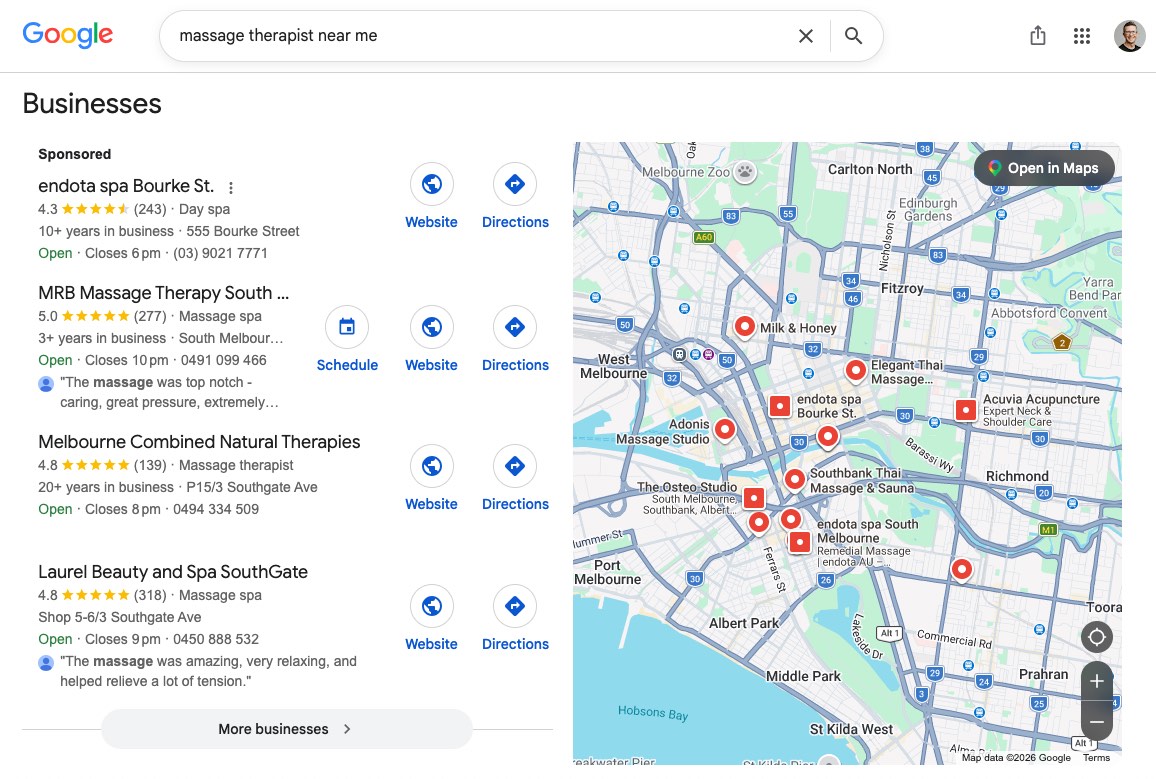
The simple story: Google Maps and local search results are still where the vast majority of massage clients look first – especially for direct "massage therapist near me" searches.
AI search is growing fast and matters more every month, and AI search results are also included in Google, as well as dedicated AI chat tools like chatGPT or Claude. AI is very useful for the broader questions people ask before they've decided to book. So you need both, but the map is most important.
Getting found on Google Maps
Your "Google Business Profile" is the free listing that powers Google Maps – and I'd say it is the single highest value piece of marketing available to a massage practice. And it's free, and available to everyone!
So here's how to make the most of it:
Claim and verify your Google Business Profile at google.com/business if you haven't already – this is the free listing that shows your pin on the map.
Fill in every field: business category (e.g. "Massage Therapist"), service area, opening hours, phone number, and a link to your website.
Keep your name, address and phone number identical everywhere online (your website, Facebook, directories). Inconsistent details confuse Google and can hurt your results.
Add real photos of your studio, treatment room and team – listings with photos get significantly more clicks and direction requests.
Collect Google reviews and reply to every one. Reviews help your listing to appear more often, and around 98% of consumers check reviews before choosing a local business, so reviews are doing a lot of the trust-building work for you.
Post updates regularly (specials, new services, availability) through your Business Profile if you can. Google rewards active listings.
List your specific services (deep tissue, pregnancy massage, remedial, sports massage) inside the profile itself, not just on your website.
What about AI search, like ChatGPT?
AI tools like ChatGPT and Google's "AI Overview" answer questions by summarising and citing content they find on the open web – the AI is basically of "pre-searching" the internet and then telling you what it found.
This basically means that if your website appears well in Google and has useful info on it that people are asking about, then AI will read that and identify your site as a source.
It's also encouraging that business and service sites make up 50% of all the links ChatGPT cites as sources, so a well-built massage therapy website has a genuine shot at being linked directly from AI as a recommendation.
The catch: AI tools still handle local search worse than Google Maps – they often can't show a proper map – and 67% of people don't fact-check what an AI tells them about a business, so getting your details right everywhere really matters.
So right now AI isn't replacing Google Maps for "find me a massage therapist nearby" searches, but it's often answering questions like "what type of massage is best for lower back pain" – and this is where the opportunity lies to make the kind of content that can lead your ideal client straight to you.
What your website actually needs to do
Your website has only three simple jobs:
Clearly and simply tell Google (and AI) what you do and where – your treatments, your suburb, your service area.
Answer the real questions your future clients are asking – in plain language, on your own web pages. Answer the exact questions you think your ideal clients would type into AI chat.
Build trust and offer the booking – through reviews, real photos, and information that's accurate and consistent everywhere it appears.
If you have a basic website already, you've already done the hardest part. But now we want to ensure it is working for you as an amazing marketing asset.
Your step-by-step website checklist
Put your suburb/city in your page titles and headings. Using "Remedial Massage in [Your Suburb]" helps far more than a generic "Welcome to My Clinic."
Create a separate page for each main service (e.g. deep tissue, pregnancy massage, sports massage) rather than cramming everything onto one page – this gives Google and AI tools more specific content to match to searches.
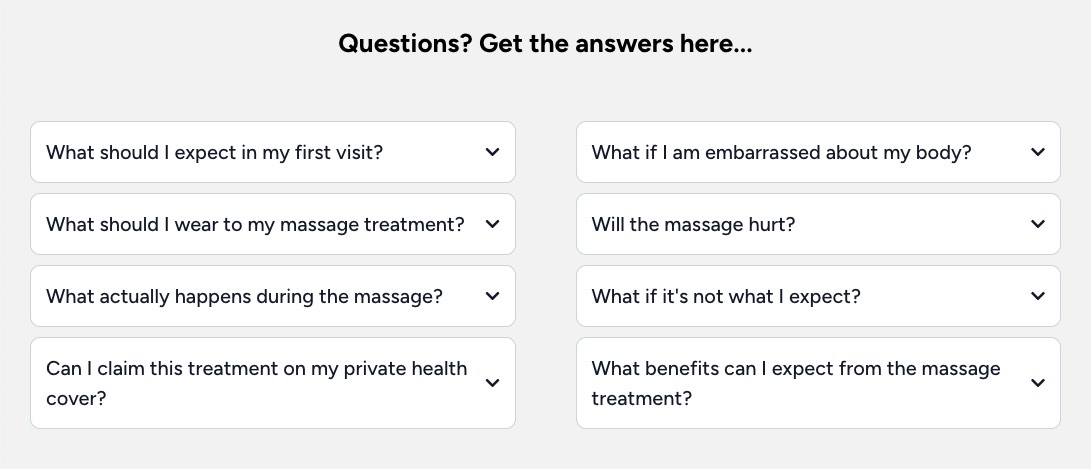
Add an FAQ section to your homepage or services page answering real questions clients ask ("How long should a massage session be?", "Do I need a referral?"). AI tools love clearly written Q&A content because it's easy to quote directly.
Make sure your site works well on mobile – most local searches happen on a phone, and a clunky mobile site hurts your results.
Add your business name, address and phone number to your website footer, matching your Google Business Profile exactly.
Get listed in other reputable directories (industry associations, local business directories) – these links act as votes of trust for both Google and AI tools.
Keep your site fast and simple – avoid huge, messy pages or massive images that might slow down load times.
Update your website occasionally with fresh content (a short blog post, a new team member bio, updated service info). An active, current site is trusted more than one frozen in 2019, and avoids people wondering "is this place even still open?"
Ask a few happy clients to leave a written review mentioning specific treatments – genuine, detailed reviews are strong trust signals for both humans and AI. If they leave the reviews on Google (which is awesome) you can copy and paste a handful to your website.
Great! Now what happens next, when people start finding you, and visiting your site?
There can be a whole lot more that can be done to your website next to encourage them to book in – but this is a great start to have it getting found in Google and in AI chat searches.
The simple bottom line
Get your Google Business Profile in excellent shape first – that's still where most massage clients are looking.
Then build a clear, honest, mobile-friendly website that answers real client questions in plain language.
When you do those two things well – you'll show up in Google's map results, and be positioned well for being linked from AI tools answering broader questions.